Andy the Muppit
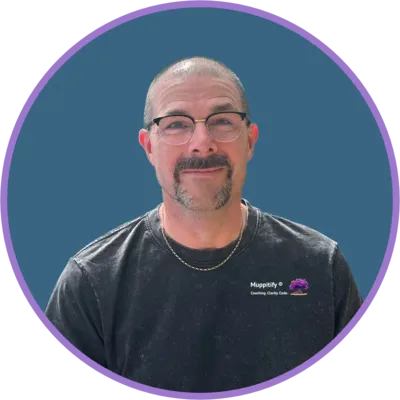
I’ve always been curious about how things work. That curiosity has helped me solve problems others thought were impossible. It has supported my education and given me the courage to take chances.
I learn by doing, not talking. Find your purpose, build something, and learn from the many mistakes along the way.
In no particular order, I love running, motorbikes, playing guitar, telling dad jokes, and Underpants Gnomes.
Muppitify
Muppitify® is the philosophy behind everything I build and how I work. The full description, principles, and reflective lens are on the Muppitify page.
Resilience and focus
I am at my best when completely absorbed in a task. I am built to persevere. The phrases I keep in mind are “to persevere” and to “never give up.”
Resilience for me is not only carrying on, it is a mindset to:
- Focus on what matters more than what is most urgent.
- Do not get carried away by negative emotion.
- Adapt quickly to change and reversals of fortune.
- Concentrate on what I can control and not on what I cannot.
This is the same stance I bring to engineering and to coaching.
My quick gnome check for any plan
- Phase 1 → Inputs. What are you actually doing and for who.
- Phase 2 → Mechanism. How exactly do those actions create value, through which channel, with what conversion, and at what cost.
- Phase 3 → Outcome. Who pays, when they pay, and what the unit economics look like.
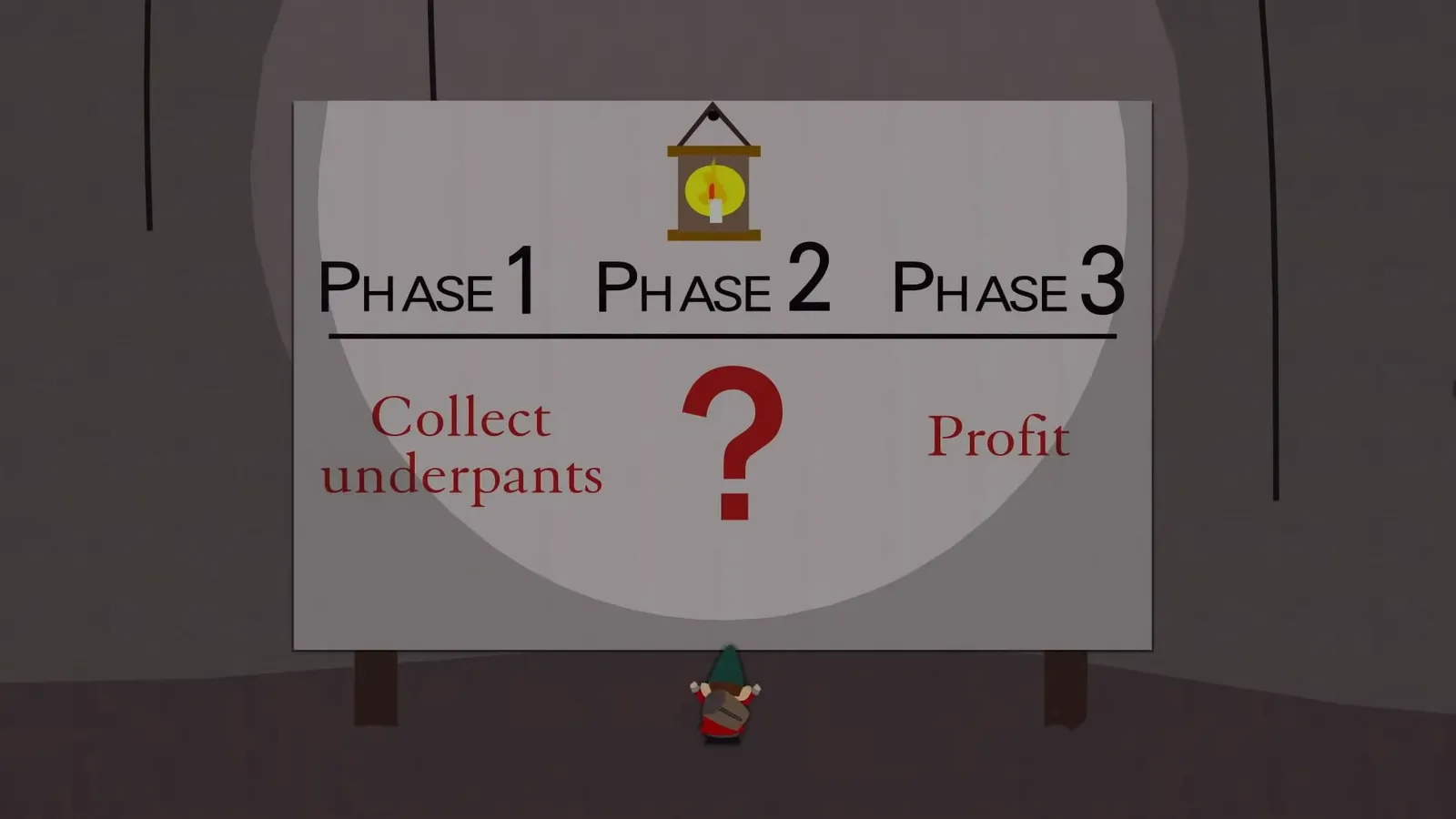
If I cannot write a convincing Phase 2, then I have an Underpants Gnomes plan. Sometimes that's enough for me to take a chance.
Early years
I wasn’t particularly strong in most school subjects and even managed an ungraded score in English (my only language!). When the first home computers arrived around 1980, everything changed. My school had a single Commodore PET and, by 1982, a couple of BBC Micros. I convinced my parents to buy a Commodore VIC-20. We didn’t have much money, so they used a hire-purchase scheme. I still remember the shop where we bought it, although it is no longer there. The only “A” I received at school was in computer studies, thanks to coding on that home computer.
Fun fact: The computer was bought for both my sister and me. I used to trade and barter with her for more time to code.
Radio and telecommunications
After school, I trained as a radio officer for four years. The rapid decline of UK-registered shipping in the late 1980s meant far fewer positions. In my group, only two people worked as radio officers, and the role became obsolete in 1999. I transferred those skills into telecommunications. I started as a support engineer and, over 15 years, progressed to principal engineer: the go-to person for complex problems and technical training.
In the early 1990s, Cable & Wireless ran a fantastic engineering college at Porthcurno. It began as a telegraph station in 1870 and became a major hub for international telegraph traffic. The courses were the best I have taken: a full month on site at a time, covering radio, fibre, and data. The trip from my home to Penzance was at least five hours, and the closer I got, the slower it became due to small roads and caravans. Unfortunately, the college at Porthcurno closed around 1993 and training moved to Coventry, which did not have the same character, before that programme also closed. I loved working for Cable & Wireless and my team was the best. This article provides an interesting history of Cable & Wireless.
Sometimes you need to take a chance and throw yourself into the abyss to transform. I have faced the unknown, gone down into what was frightening, and come back changed. You can too.
London, networks, and taking a chance
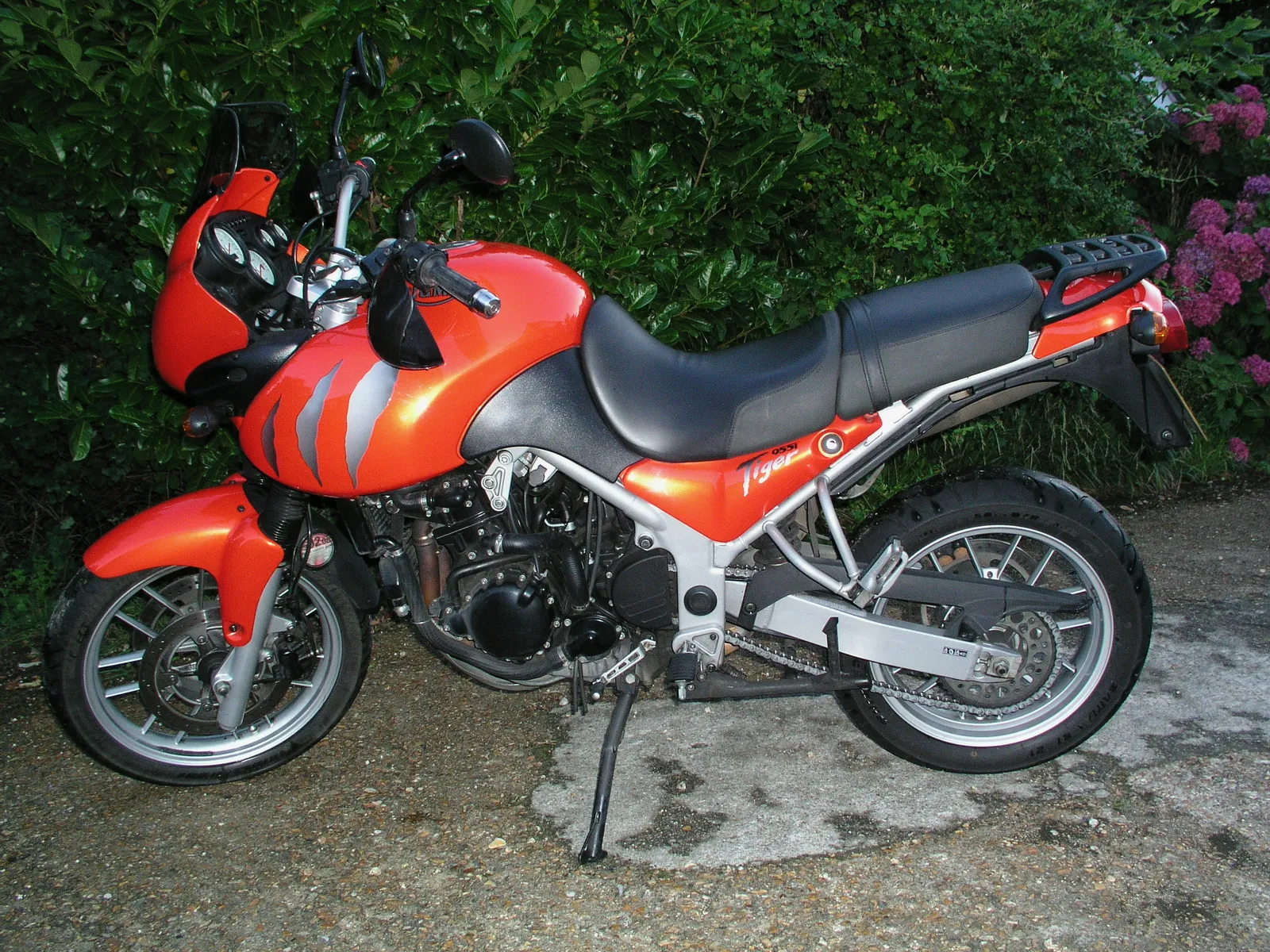
I then joined a cloud service provider in London and quickly deepened my knowledge of IP networks across Europe. The daily commute was a five-hour return trip in all weather on my motorbike: a Triumph Tiger 955i with top box, side panniers, and wire wheels (a real pain to clean). The provider was based in Docklands and my route took me past Buckingham Palace and down The Mall every morning. I left at 06:00 most days and often did not get back until 23:00. One winter, after a long day, I briefly fell asleep on the M3 near Basingstoke and ended up on the A303 slip road. It was a miracle I did not come off. It was the first, and only, time I fell asleep on a motorbike.
I moved from support into an architectural role, where I helped land a major client by introducing new technology. We delivered three separate services, multiplexed over a single physical connection, which was new at the time, to create a distinct product. Despite strong pushback from the Chief Technology Officer (CTO), and a clear warning that failure would cost me my job, I worked with the product team and project-managed the delivery alongside my day job. The project succeeded and led to more large orders.
Perth, enterprise architecture, and taking a chance
My wife and I decided that Australia would be a better place for our children and we quit our jobs and sold our house. It was difficult to get interviews for Australian roles from the UK, so I bought a one-way ticket to Sydney and planned to stay on a friend’s floor until I secured work and a place to live for my family. The day before I was due to fly, an ICT service provider in Perth contacted me about a new client project. They needed my knowledge of Multiprotocol Label Switching (MPLS), Border Gateway Protocol (BGP), and Open Shortest Path First (OSPF) to architect and build private, redundant data centres and networks for their service layer. They hired me on the spot and paid for the flight from Sydney to Perth. I landed in Sydney at midnight, flew out again at 06:00, and was at the customer site that afternoon. A month later I flew back to the UK and moved the family to Perth, eventually becoming an enterprise architect. After several roles across ICT providers, I joined a large mining company as IT and Communications Manager and, after five years, was promoted to Chief Information Officer (CIO). I was accountable for all IT and communications across the group, reported to senior executives, and provided white-glove support to the Chair and board for a further six years.
AI, data science, and taking a chance
I could have remained in the role of CIO; instead, I created a new AI department for the group. I was trusted to build, design, and operate an in-house, air-gapped AI platform on clustered GPUs, reducing reliance on cloud vendors and improving data security. I analysed data, built predictive models in Python, and delivered in-house applications across business units.
AI today gives me the same excitement and possibilities that my first home computer did in the early 1980s. I can now create working software in days that once took months. Just as my home computer was a tool, so is AI.
Today, self-employed, and taking a chance
Today I step into short-term and fractional roles where teams need someone who can deliver under pressure. I also build local-first, on-premises applications that keep data private and costs low. I coach IT, communication and engineering professionals, take selective consulting engagements on complex cross-domain technical problems, and build software for the work I care about. The Muppit Sphere is where I share all of it.
For details on how I build, see Technical foundations.
Contact
- Connect on LinkedIn: Andrew Reid.
- Read my Musings - LinkedIn posts and personal reflections.
- If you want to work with me, see coaching or consulting.
A note on the inner Muppit
I once ran my first marathon by accident while training for my first half-marathon when I reached a crossroads. Left was the unknown. Right was home. I chose left. No plan, no support, no drink, food or gels, on my own, a spur-of-the-moment test to see what was possible and what I was capable of. In retrospect I believe I subconsciously set it up like that to remove any distractions so that I could maintain focus. That choice turned into four hours of steady movement. Near the end, the hills hurt and I wanted to stop, yet purpose kept me going. My purpose in that moment was simple: finish a marathon when I had not even run half that distance before. I was tracking my time and as I got closer to the full distance I asked myself “can I complete this in 4 hours? is it possible?” My answer was “no idea, but I am going to give it everything I have”. That focus carried me over the last climbs, with a sprint at the end. That day did not invent Muppitify, but it showed me what clear purpose can unlock. Choose the path that builds capability. Cut what is not essential. Keep going.
The exhilaration of seeing my Garmin show 3 hours, 59 minutes and 51 seconds with an average pace of 05:41 min/km gave me chills, and it still stays with me. I have not bettered that time, though time is no longer the reason I continue to run.
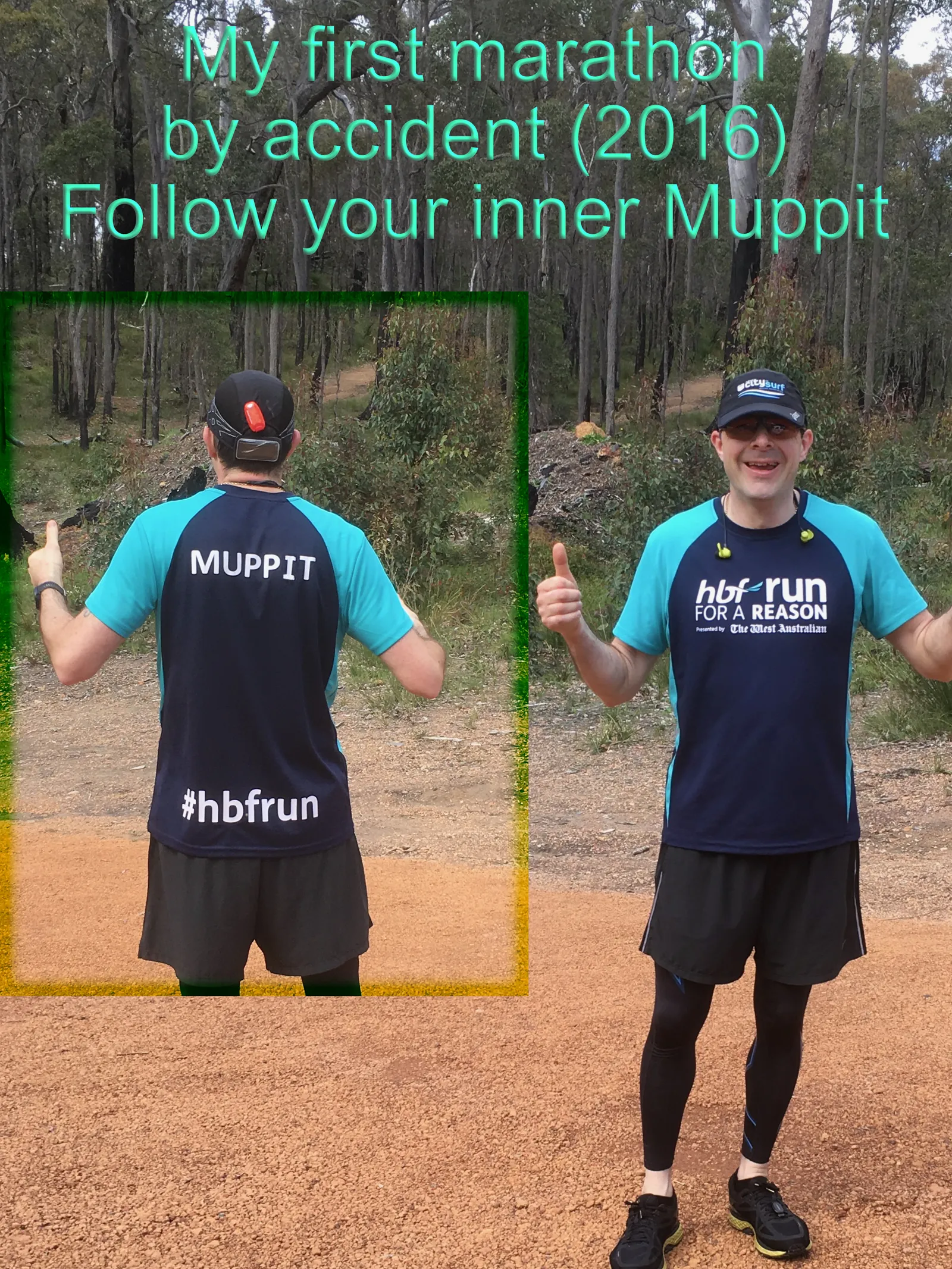
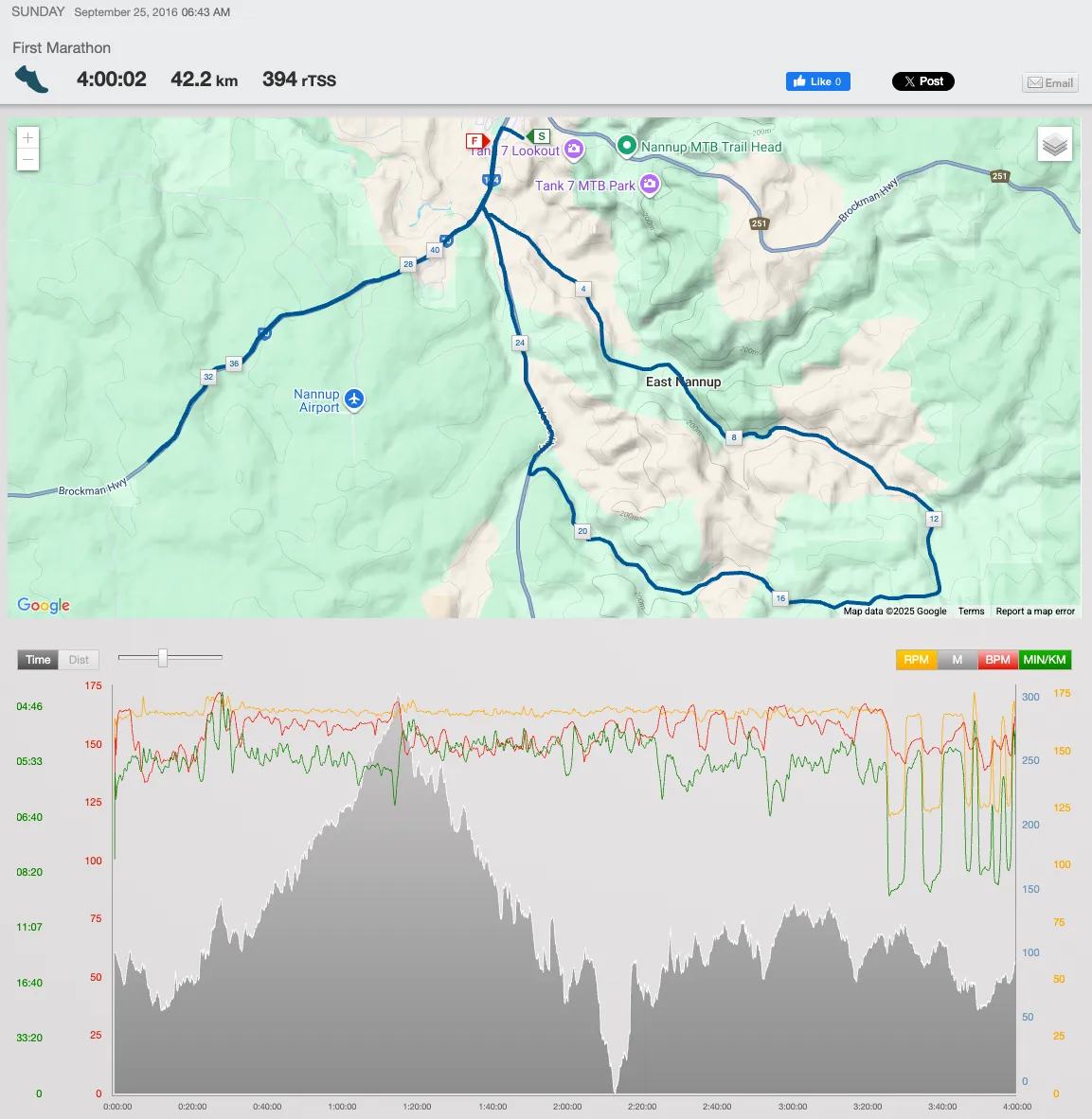
A year later I ran my first official marathon in Perth. After four months of dedicated training I felt in optimal condition. Three days before the race I stood on my son’s small yellow traffic cone and it went straight through my heel. My wife stitched it up and bandaged it, but it was extremely painful to walk on. I went to the race with no intention of running, just to take in the atmosphere. However, I brought everything with me, and when the gun went off I ran with everyone else. It was an out and back course along the river. I told myself if I can get to the turn, then I have to come back to the car. The pain was bearable for the first half, but just after the turn, around 26 km, the pain kicked in. During the first half my pace was 05:40 min/km; in the second half it was 09:17 min/km. I endured and did not give up. That has become my motto: Never Give Up. It also showed me how I can change my purpose in the middle of a task. I honestly felt I could run injured and still finish a marathon in four hours. When that reality changed, I changed my purpose to simply complete the marathon, no matter how long it took, even if I had to crawl to the finish line. It still amazes me what we can do when we commit.
The inner Muppit is that voice telling you to try, to learn, and to keep going.
This site is me following it, and an invitation for you to do the same.