The song I didn't know I had to write
In December 2023 I was burnt out, though I did not have a name for it then. Just a collection of symptoms: exhausted, unable to think straight, high stress, poor health. I weighed nearly 100kg and was in what I can only describe as a pit of despair.
By June 2024 I had lost 20kg, reversed Type 2 Diabetes, and understood for the first time why I kept burning out. The catalyst was not a book, a coach, or a productivity system. It was writing a song.
This page covers the songwriting journey that helped me understand burnout. For the detailed sequence of actions that got me physically ready, see Physical recovery.
How it started
In April 2024 I booked a few days alone in Busselton to record a song about my uncle who had passed away many years back. I had been writing songs and playing guitar on and off for years but never released anything. This time would be different, but not how I expected.
There was one problem: I had recently injured my wrist at the gym, so even though I brought my guitar and recording equipment, no matter how hard I tried I could not hold the chords. Instead of recording, I spent the days running along the ocean paths.
On the last night I opened an email about an AI songwriters course. The name was misleading: there was no AI music generation, no Suno, no Udio, just a structured four-week process to write, record, and publish a song. I signed up, starting 13 May, with the full intention to finally publish one of my songs.
Looking back, everything lined up. The wrist injury stopped me recording the song I had planned. The quiet time made me receptive to notice an email I would normally ignore as spam. The course gave me a container to work in.
The lyrics that found me
I started with four chords on a loop and no lyrics, but the words would not come. I sat in my home studio staring at the screen, playing the same progression over and over, waiting for something, anything, but it wasn't happening.
I changed my approach. I started recording voice memos on my phone while walking around Kings Park. Something about being outside, moving, taking in the smells of flowers and the kookaburras laughing. Kings Park is beautiful. I started with describing how I was feeling, then phrases, feelings and half-formed ideas. I recorded them all.
I started bringing my guitar to work, strapped to my back if I rode to work on my motorbike. At lunch, I would take it to a park bench and play. At first I felt self-conscious, worrying about the people around the park, but eventually I let that go. With limited time I just focused on what mattered which was writing my song.
The words found me when I stopped trying to force them.
First came "round and round" like being stuck on a roundabout with no exit. Then "down and down" as I dug deeper. Finally "well of despair" arrived and I understood: I was writing about burnout.
Round and Round
The first complete version had a simple melody that captured the feeling of being trapped, spinning, with no way off.
--- Verse 1 ---
Now and then I feel so alone
Walking through this crowd of faces I don't know
I'm out of place
It's on show

--- Chorus 1 ---
Round and round I go
How far, I just don't know
I'm spinning around
Somebody please

--- Verse 2 ---
Like a fish out of water
Not understanding words that they say
I'm on edge
It's on display

--- Chorus 2 ---
Round and round I go
How far, I just can't say
I'm spinning around
Explain to me, I don't know

--- Verse 3 ---
Falling down
I'm falling down
My heart's on the ground
I'm begging you

--- Outro ---
Round and round I go
How far, I just don't know
I'm spinning around
Somebody please
Well of Despair
Writing this song was like a therapy session where I kept digging. The course feedback said: "Please let me know how it makes you feel."
The lyrics got darker as I was no longer spinning on a roundabout but falling into a well.
--- Verse ---
It's hard to explain
I can't put my finger on it
But I don't feel right
I'm like a powder keg about to ignite
Will I fight
Or die tonight?
Will they miss me if I am gone
(Now and then I feel alone)

--- Chorus ---
Does my life have any meaning?
I'm in darkness, I cannot see
I'm lost in the shadows of my mind
What's left for me?
Down and down I go
How far I just don't know
I'm falling down, somebody please
My heart's on my sleeve

--- Verse ---
My pain's buried down
Sunk in a well of despair
Am I beyond repair
I'm trying but I can't wake from this nightmare
Start a fight
Or die tonight
Will you miss me when I am gone
(All around me will suffer)

--- Chorus ---
Does my life have any meaning?
I'm in darkness, I cannot see
I'm lost in the shadows of my mind
What's left for me?
Down and down I go
How far I just don't know

(There's no where left to go)
Final version: The turn
The finished song has a turn at the end that I did not plan, where my despair transforms into hope. The lyrics wrote themselves that way and I did not force it.
--- Verse ---
It's hard to explain
I can't put my finger on it
But I don't feel right
I'm like a powder keg about to ignite
Will I fight
Or die tonight?
Will they miss me if I am gone
(Now and then I feel alone)

--- Chorus ---
Drowning in a well of despair
Drowning in a world of despair
Drowning in a well of despair
Lost in the shadows of my mind
Lost in the shadows of my mind
Lost in the shadows of my mind

--- Bridge ---
Down and down I go
How far I just don't know

--- Verse ---
My pain's buried down
Sunk in a well of despair
Am I beyond repair
I'm trying but I can't wake from this nightmare
Start a fight
Or die tonight
Will you miss me when I am gone
(All around me will suffer)

--- Chorus ---
Drowning in a well of despair
Drowning in a world of despair
Drowning in a well of despair
Lost in the shadows of my mind
Lost in the shadows of my mind
Lost in the shadows of my mind

--- Chorus (The Turn) ---
I'm pulling myself up
Out of this hole
Fight and stay alive
I'm going to fight to survive
Building the song
I did not know when I started this that it would take 24 iterations and 40 tracks to not only express my feelings but, more importantly, to find something new with each one. I only stopped when it felt complete to me, and that is when I mastered it.
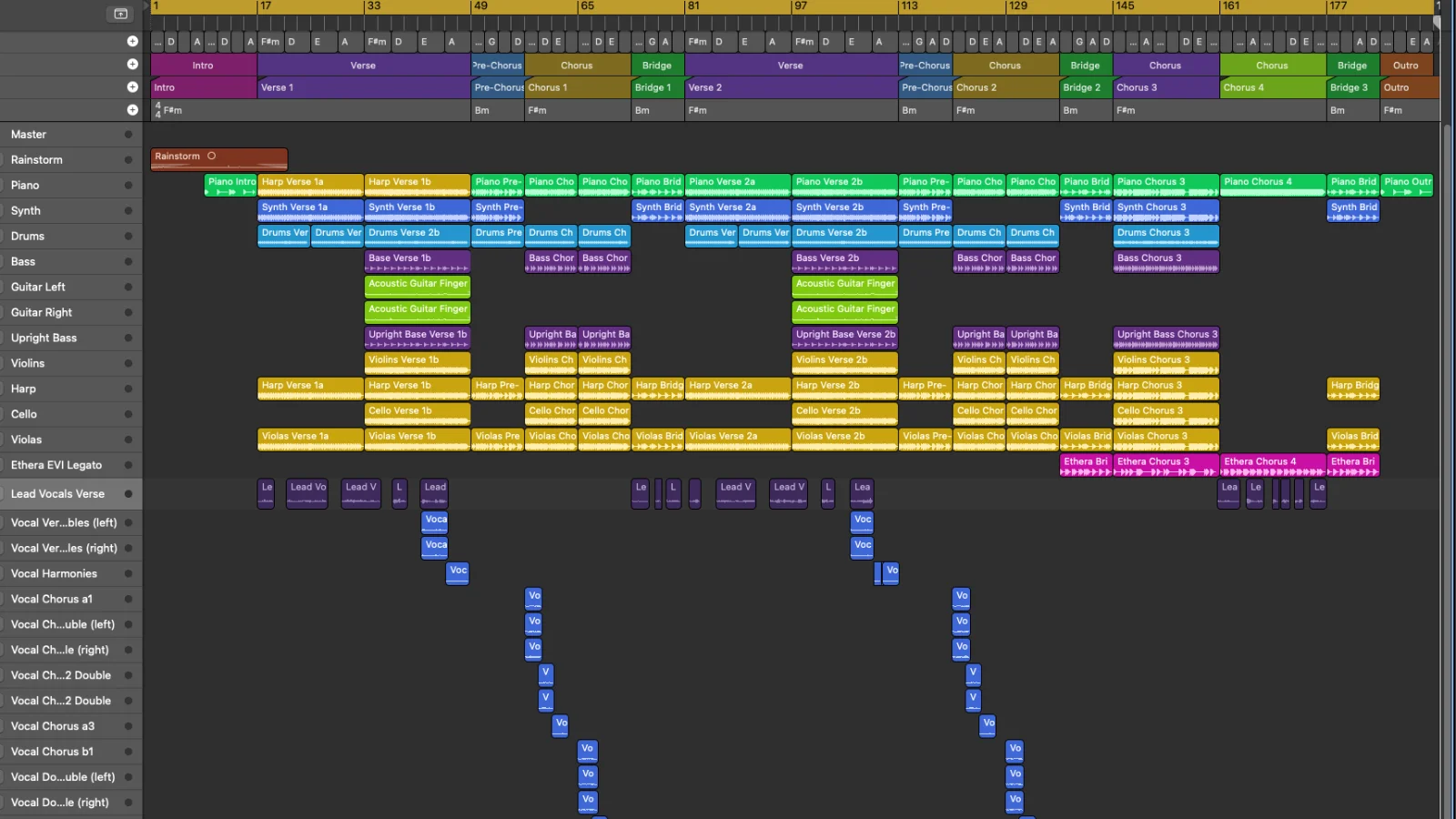
The full arrangement in Logic Pro with 40+ tracks
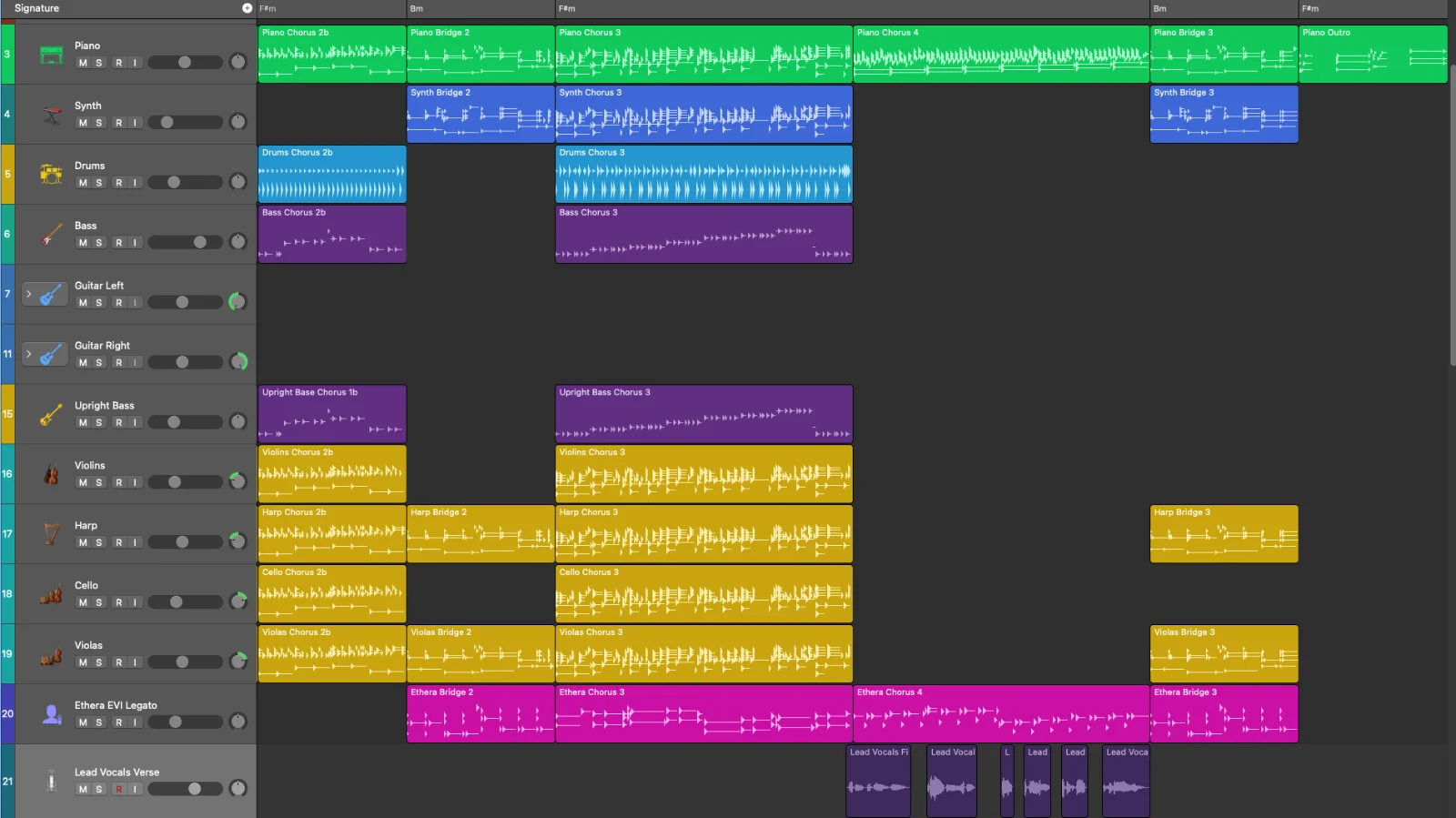
Layered vocals, guitars, strings, and synths
The sound of the rainstorm in the intro was recorded live on my iPhone in my back garden during a heavy thunderstorm with lightning lighting up the sky. It expressed the turmoil I was feeling.
I wanted the ending to build to a crescendo with violins and harps. The first time I played my finished song I was bawling my eyes out at the end.
Also available on my Therapy playlist on SoundCloud.
What I learned about myself
The process changed how I understood burnout.
I was never fulfilled. The hit of pleasure when completing a project was fleeting. I sought bigger and bigger projects, impossible ones, and completing them was still not enough. This led to repeated burnouts: December 2023 was not the first one. Reflecting on them now that I am aware of burnout, each subsequent one had a lower trough than the one before it and they were getting closer together. It was like the pressure was never fully released, only partially each time, so they built on each other.
I recall when my sister came to visit from the UK in April 2023. We had not seen each other in person for nearly 10 years and I took 3 weeks leave from work to be with her. The first week she was here I was in bed, shaking with a fever. It was not a bug, it was because I had stopped working and everything I was carrying hit me like a ton of bricks. I did not know about burnout or how to manage it at that time.
My self-imposed pressure started at college. I failed school and my career counsellor had no idea what I would be good at, but at college I started excelling, getting top marks for the first time. That imprinted on me and I chased achievement ever since.
I always said yes. I believed a company is either growing or shrinking, never stable. So I took every opportunity, every challenge. The result was self-exploitation disguised as ambition.
I never took time to contemplate. Before this song, I had never stopped to think about why I did what I did. The process of writing the song, because it was so personal, forced me to address the root issues instead of ignoring them, running from them into busy work projects.
The growth mindset trap
Carol Dweck's book Mindset changed how a generation thinks about learning and achievement. The core idea is compelling: people with a growth mindset believe abilities can be developed through dedication and hard work, while those with a fixed mindset believe abilities are innate and unchangeable. Growth mindset leads to resilience, learning from failure, and sustained effort. I read her book, and then also listened to the audiobook with her narration.
What Dweck does not cover is the long-term cost of persistence.
I was raised in a growth mindset family, though we never used that word. The message was clear: if you work hard enough you can achieve anything, failure is just feedback, keep going, never give up.
I internalised this completely. I was extremely persistent in everything I attempted. When I failed school, I did not conclude I was not smart enough. I went to college and worked harder. When projects got difficult, I pushed through. When I was exhausted, I pushed through. When my body was screaming at me to stop, I pushed through.
This persistence accelerated my burnout cycles, and the same trait that helped me succeed was slowly destroying me.
Growth mindset assumes that effort leads to growth, but it does not account for what happens when effort leads to depletion, when persistence becomes self-exploitation, when "never give up" becomes "never rest."
The dark side of growth mindset is that it can make burnout feel like a personal failure. If you just tried harder, pushed more, believed more strongly that you could develop and improve, you would not be burnt out. The problem must be insufficient effort, insufficient belief. So you try harder and burn out faster.
I needed to learn that sometimes the right response to difficulty is not more effort but stopping, changing direction, and accepting that some paths lead nowhere no matter how hard you work.
How I operate now
I have changed my operating model fundamentally. Instead of persistence alone, I now use a combination of persistent direction and perseverant problem solving.
Persistent direction means I stay committed to where I want to go: my goals, my values, what I am building towards. That does not change easily because I am still ambitious and still want to achieve things that matter to me.
Perseverant problem solving means I keep changing how I get there. When reality hulk smashes my plans, I do not double down on the original approach but adapt and try something different. I accept that my first idea, second idea, tenth idea might all be wrong, and that finding what works requires experimentation rather than stubbornness.
The direction stays steady while the tactics change.
This feels fundamentally different from how I operated before. Previously, I would commit to a goal and then commit equally hard to a specific way of achieving it. If the approach was not working, I would try harder at the same approach with more hours, more intensity, more will.
Now I hold my methods loosely. When something is not working, I ask whether the method is wrong rather than assuming I need to work harder. Sometimes the answer is still "try harder" but often the answer is "try differently."
This protects me from the burnout cycle. When I feel resistance, I no longer automatically interpret it as a sign I need to push through. I consider whether the resistance is telling me something useful. Whether the path I am on is the right one, or whether I am persisting out of stubbornness rather than strategy.
The song taught me this. I could not force the lyrics. I had to change my surroundings, my approach, my expectations. When I stopped trying to write a song about my uncle and let whatever needed to come out actually come out, the song wrote itself.
The irony of the AI songwriters course
The course name promised AI but delivered none: just a structured four-week programme with pre-recorded videos, peer feedback, and deadlines, with no instructor engagement and no AI music tools.
In fact, the course was discontinued after my cohort, making me part of the first and only version.
The irony is that I joined an AI course expecting cutting-edge tools and instead got something far more valuable: a container for reflection, a reason to sit with difficult feelings, and a deadline that forced me to finish something.
Sometimes the thing you need is not the thing you think you are signing up for.
The moment everything changed
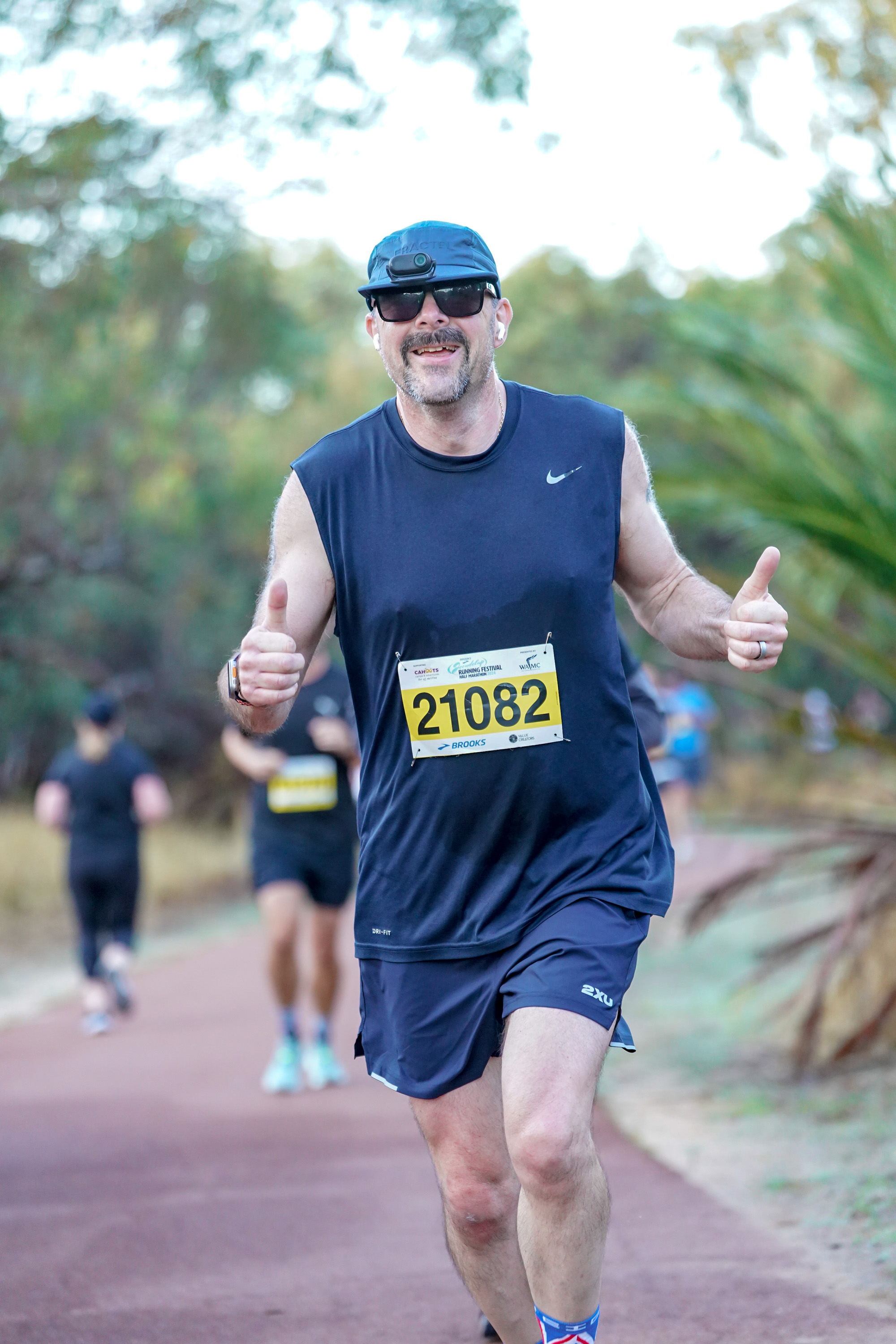
During the Joondalup half marathon on 26 May, two kilometres from the finish, I passed a man who had stopped and looked in trouble. I kept running, then turned around and went back to him.
His name was Stu and I encouraged him to start again at a slower pace. We finished together because I wanted him to cross the line before me.
I had just written the lyrics to Well of Despair which made me hyper-aware of people struggling. My finish time no longer mattered because I will remember helping someone in trouble long after I forget the race result.
What I read afterwards
After finishing the song I researched burnout properly for the first time.
Byung-Chul Han's The Burnout Society resonated. His argument: we have moved from a disciplinary society (external control) to an achievement society (self-imposed pressure). We exploit ourselves in ways no external oppressor could enforce. Burnout, depression, and anxiety are the defining ailments of this shift.
Han advocates for contemplation, rest, and genuine human connection. The song had already taught me this, and the book gave me language for it.
The song is not released
I completed the song on 10 June 2024. I had already published a song commercially, Get Away on Apple Music in September 2023, but I chose not to publish this one. The value was in the process, not the product. Understanding my burnout, finding my voice (literally and figuratively), and sharing unfinished work with family and friends for the first time was what I needed. Publishing it to the world felt unnecessary.
Today I have made all my original songs on SoundCloud public, including this one. Not for commercial reasons, but because sharing vulnerability is part of what the song taught me. You can explore all my original songs.
The song is rough, it may not be music, but it is real and is exactly what I needed. You can play it in the "Building the song" section above or find it on my Therapy playlist.
If you are burnt out
You probably do not need another productivity system. You might need something that forces you to sit with how you actually feel.
For me it was a song and for you it might be something else, but the medium matters less than the honesty.
The lyrics will find you if you let them.