Muppitify
Muppitify® is my way of aligning engineering craft with human purpose. It is the umbrella for everything on this site: the coaching practice, the consulting work, and the software I build. Each is a different expression of the same idea, that the tools, systems, and conversations we create should serve something we actually care about.
The philosophy
Muppitify blends three lenses:
- Ikigai: noticing what already makes life worth living, through attention to detail, freedom to be yourself, harmony with others, and the joy of growth.
- Coaching: clarity of intent, small experiments, honest reflection, and accountability so insight turns into action.
- Engineering: modular design, local-first operation, automation with guardrails, and documentation that outlives the author.
In practice that means small, well-named pieces; running the essentials on infrastructure you control; GitOps with rehearsed reversals; and runbooks others can repeat. The aim is the same for clusters and for people: less drift, more deliberate change, and a clear "why" behind each step.
Principles
- Modular by default: small pieces, well named, well documented.
- Own your core: run the essentials locally, connect out on your terms.
- Automate with rollback: pinned versions with why-comments, and rehearsed reversals.
- Design for failure: health probes, requests and limits, basic network policy.
- Learn in the open: share runbooks and lessons so others can replicate the path.
Four rules I keep coming back to
- Fit for purpose: solve the real problem, not the imagined one.
- Automatic: repeatable with minimal manual steps.
- Observable: easy to see what is happening and why.
- Reversible: change it, and change it back safely.
Where it shows up
The philosophy runs through everything on this site. In the coaching practice as directness, clarity, and honest push-back. In the consulting work as methodical cross-domain diagnosis. In the Coaching Platform and Transcript Prep as local-first, privacy-respecting tools that coaches own and control.
The reflective lens
Ikigai is not the Western four-circle Venn diagram. The original concept, as described by Mieko Kamiya and later by Ken Mogi, is closer to the feeling of being alive with purpose. It is not something you find once and hold. It is something you notice, lose, and notice again.
I use four thresholds drawn from this tradition as a reflective lens in coaching and in my own practice:
- The Joy of Small Things (kodawari): attention to detail and daily ritual.
- Being Free to Be Yourself (jibun rashiku): releasing oneself, letting go of performed identity.
- Harmony with Others (wa): the texture of belonging, contributing without keeping score.
- The Joy of Growth: becoming, on your own terms, not for a grade or a title.
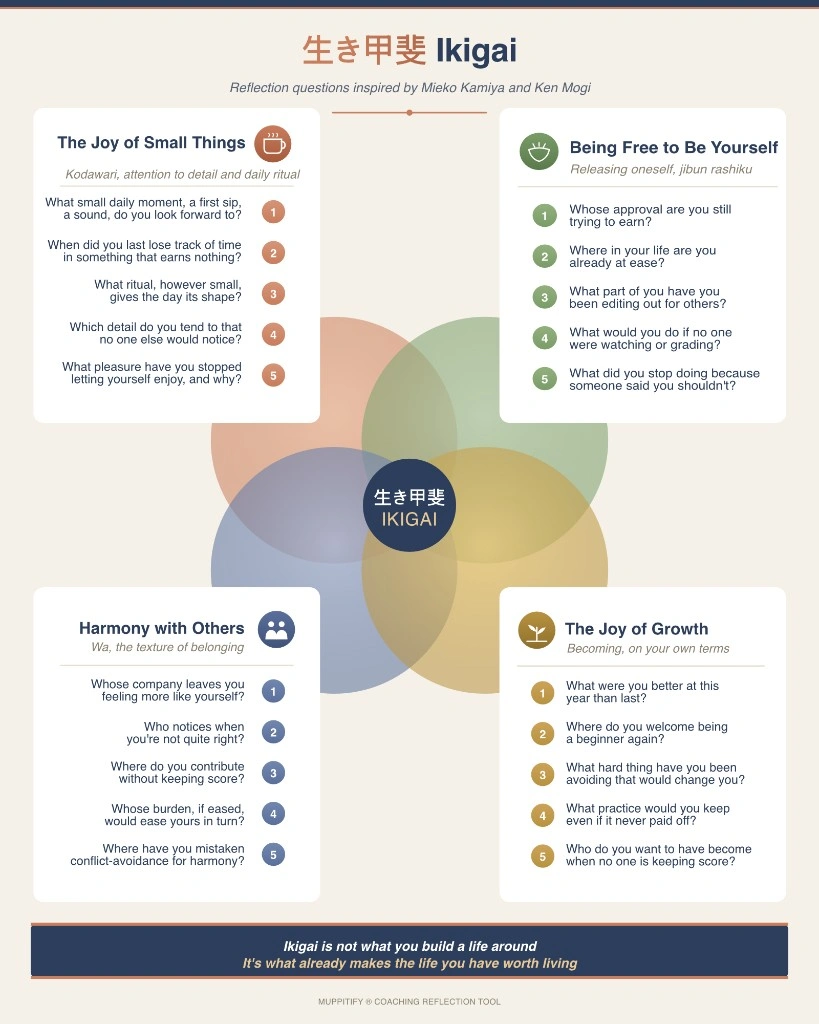
Twenty reflection questions across four thresholds. Muppitify Coaching Reflection Tool.
I created twenty reflection questions across these four thresholds for International Coaching Week 2026. The full set of questions is in the blog post, and the printable version is available as a downloadable PDF.
Ikigai is not what you build a life around. It is what already makes the life you have worth living.
Origins
The full personal story is on my about page.